

Your vehicle is intentionally restricted from the factory. Manufacturers leave significant performance on the table to account for low-grade fuel and poor maintenance in global markets. Safe engine remapping allows you to reclaim this lost potential whilst protecting the turbocharger, fuel system, and drivetrain. You likely feel the conflict between wanting more power and fearing a catastrophic component failure. It is a common dilemma; conflicting forum advice and insurance worries often stall the decision to upgrade.
Safe engine remapping is a precise, technical optimisation that respects mechanical tolerances. Professional software calibration delivers results. Improve throttle response. Increase torque. Optimise fuel delivery. This is not about pushing hardware to its breaking point; it is about refining the digital instructions that govern your engine's behaviour whilst maintaining total reliability. Secure the power. Protect the engine. Drive with confidence.
This article debunks the common myths surrounding ECU modifications and explains the reality of factory safety margins. You will discover how a Stage 1 Power Tune stays within safe limits, why insurance transparency is non-negotiable, and how to correctly maintain a high-performance vehicle. Learn to distinguish between reckless tuning and professional calibration. Gain the technical truth behind performance software.
Key Takeaways
- Learn why manufacturers detune engines and how safe engine remapping recalibrates software within strict mechanical tolerances.
- Identify built-in safety protocols. Understand torque limiters. Protect your gearbox, clutch, and drivetrain from excessive stress.
- Recognise the risks of generic tuning files. Prioritise bespoke calibrations that adjust for your vehicle’s specific age, mileage, and health.
- Verify professional standards. Check for genuine hardware tools. Insist on comprehensive pre-tuning diagnostic scans to ensure reliability.
- Leverage data-driven optimisation and verified software recipes to unlock performance whilst maintaining total mechanical integrity.
Debunking the Fear: Is Engine Remapping Inherently Dangerous?
Fear usually stems from a lack of technical understanding. Safe engine remapping is the precise recalibration of ECU software within established mechanical tolerances. It is not about bypassing safety protocols; it is about optimising them. Unlike crude "tuning boxes" that simply trick sensors with false data, a professional remap involves modifying the actual tables within the Engine Control Unit, such as those found in modern Bosch or Continental systems. This technical process, historically known as Chip tuning, allows for a more holistic and reliable performance increase.
Manufacturers do not tune for maximum efficiency. They tune for global standardisation. Vehicles sold in Ireland share the same software maps as those sold in regions with poor fuel quality, extreme ambient temperatures, and irregular service intervals. This "lowest common denominator" approach leaves massive headroom. By recalibrating for high-quality Irish fuels and our temperate climate, we safely adjust ignition timing, boost pressure, and fuel delivery. We unlock performance. We improve efficiency. We refine the drive.
The Myth of the "Strained" Engine
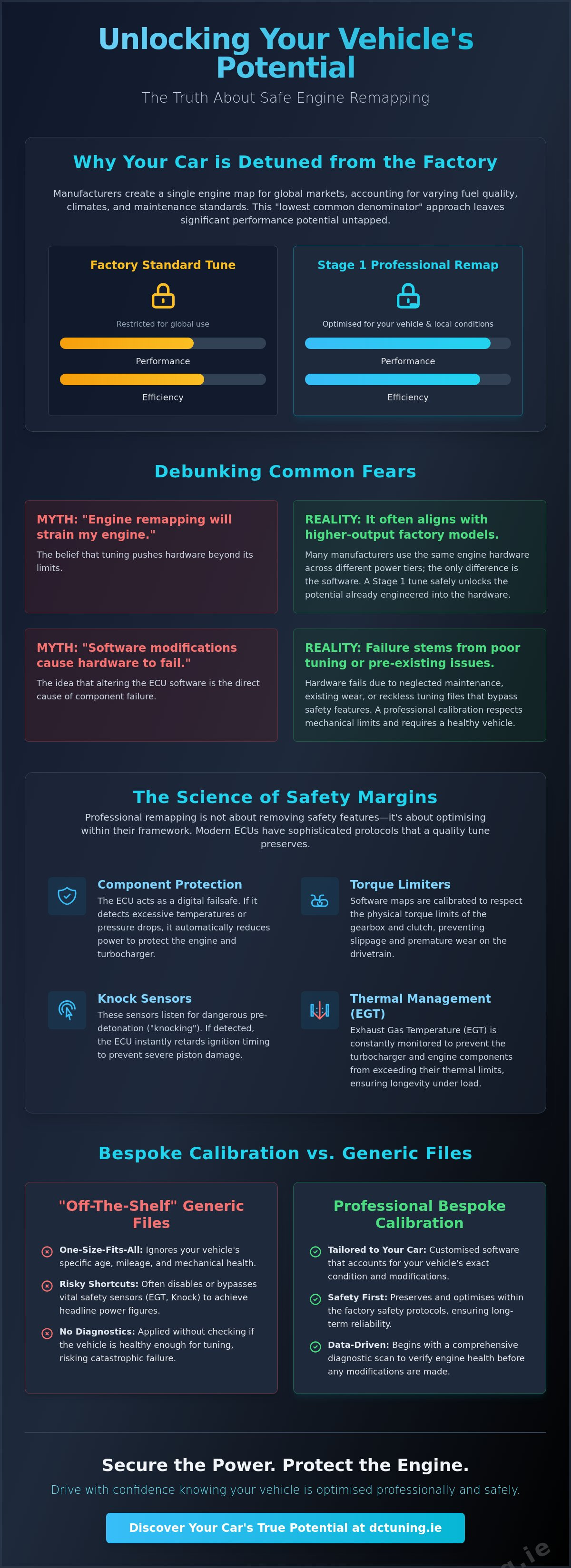
Modern automotive manufacturing relies on modularity. A single 2.0-litre engine block often serves three different power tiers across a brand's range. The hardware is identical; only the software varies. Choosing a Stage 1 Power Tune often simply aligns your vehicle with its higher-output factory siblings. Safety is defined by software quality and its impact on engine behaviour. It is about precision. It is about expertise. It is about balance.
Software vs. Hardware: Where the Risk Really Lies
Hardware rarely fails because of software alone. It fails because of pre-existing wear, neglected maintenance, or poor component quality. A professional provider always begins with Diagnostics & Fault Finding to ensure the engine is healthy enough for modification. Cheap, "off-the-shelf" files are the real danger. These often bypass EGT (Exhaust Gas Temperature) sensors or disable knock detection. Safe engine remapping preserves these vital protection maps. It monitors data. It respects hardware. It ensures longevity.
The Science of Safety Margins: How Professional Calibration Protects Your Vehicle
Modern Engine Control Units (ECUs) are not simple calculators. They are sophisticated safety systems. Safe engine remapping preserves the logical hierarchy of these systems. When a professional calibrates a Bosch or Continental ECU, they work within the "Component Protection" framework. These maps act as a digital failsafe. If exhaust temperatures climb too high or oil pressure drops, the ECU intervenes. It pulls back timing. It reduces boost. It saves the hardware.
Torque limiters are the primary guardians of your drivetrain. Every gearbox has a maximum rated torque capacity. Professional software maps respect these physical boundaries to prevent clutch slip and gear fatigue. Amateurs often "max out" these limiters, leading to premature failure. Experts refine them. They smooth the delivery. They protect the investment. They ensure reliability.
Sensors provide the data required for these safety interventions. Knock sensors monitor for pre-detonation in real-time. If the sensor detects a "ping," the ECU instantly retards ignition timing to prevent piston damage. Similarly, Exhaust Gas Temperature (EGT) monitoring is critical. It prevents the turbocharger from reaching its melting point. You can Verify a Professional Tuner by checking if their software maintains these active safety protocols rather than deleting them to chase headline figures.
Maintaining Thermal Management
Thermal load is the greatest threat to engine longevity. High-quality maps ensure that heat generation never exceeds the cooling system’s heat rejection capacity. This includes maintaining factory-set oil temperature targets to ensure the lubricant doesn't break down under load. EGT is the primary safety metric for diesel performance, acting as a real-time indicator of thermal stress on the turbine. Keep it cool. Keep it safe. Keep it running.
Torque Modelling and Drivability
Power delivery must be linear. Safe remapping mimics the factory power delivery curve, only at a higher magnitude. Spiky torque curves create massive shock loads on drivetrain components. This is particularly dangerous for the Dual Mass Flywheel (DMF), which is designed to dampen vibrations within a specific operational range. Overloading the DMF leads to excessive vibration and eventual failure. To see how your specific drivetrain can be safely optimised, explore the options available at dctuning.ie.
Off-the-Shelf vs. Bespoke: Why "Generic" Files Risk Your Engine
Generic files are the "fast food" of the tuning world. They are mass-produced. They are unoptimised. They are inherently risky. These "base files" are designed to work on the widest possible range of vehicles with the same ECU ID. However, they ignore the physical reality of the machine. An engine with 200,000km on the clock has different fuel injector flow rates, turbocharger bearing tolerances, and compression levels than a unit fresh off the production line. Safe engine remapping requires a calibration that accounts for these specific mechanical variables.
Amateur tuners often rely on "File Services." They upload your factory data to a remote server. An anonymous operator applies a template. They send it back. The person standing at your car has never seen the internal map structure. They do not understand the hex data. They are simply moving data from point A to point B. This lack of oversight is where mechanical failure begins. Professional software engineering utilises industry-standard tools like WinOLS or ECM Titanium to manipulate the raw binary data directly. It is precise. It is transparent. It is reliable.
The Problem with "Slave" Tools
Hardware choice dictates capability. Many mobile providers use "Slave" tools. These devices are locked to a specific master tuner and only allow the user to read and write encrypted files. The operator cannot see the maps. They cannot verify the safety of the timing or boost requests. Master-level engineering is the only way to deliver safe engine remapping. It allows for full transparency. It enables precision. It guarantees accountability. All Stage 1 remaps must be tailored to the specific software version and hardware health of your individual vehicle.
Bespoke Mapping: The Professional Standard
Bespoke calibration starts with a blank slate. Engineers identify map addresses in the raw hex data. They adjust parameters based on real-world feedback. This process involves logging real-time data during a controlled test drive to monitor lambda values, ignition pull-back, and exhaust temperatures. Contrast this with "power-at-all-costs" files. Those files chase numbers. Professional calibrations chase efficiency. They prioritise smooth torque delivery. They maintain factory safety protocols. They deliver sustainable performance without compromising the lifespan of the engine.
The Safety Checklist: How to Verify a Professional Tuner Nationwide
Technical competence is visible in the tools and processes a tuner employs. Do not rely on surface-level reviews alone. Start by verifying the hardware. Genuine tools like Alientech KESS3 or Autotuner are non-negotiable requirements for safe engine remapping. These devices receive constant security updates and protocol patches to ensure stable data transfer. Cloned or "cracked" tools lack checksum correction and often brick ECUs during the write process. If a tuner cannot prove their hardware is genuine, walk away.
Question the origin of the software. A professional provider either develops their own calibrations in-house or uses a verified marketplace with technical engineering support. Ask about "Back to Stock" options and software warranties. A reliable service should offer a clear path to revert your vehicle to factory settings if required. Finally, evaluate the setup. Whether it is a dedicated workshop or a Mobile ECU Remapping service, the equipment must be organised and the operator must be able to explain the technical changes they are making to your vehicle.
Critical Pre-Remap Diagnostics
Remapping a vehicle with an underlying mechanical fault is a recipe for disaster. Professional tuners always perform Diagnostics & Fault Finding before touching the software. They scan for stored error codes and monitor live data from critical sensors. The Mass Air Flow (MAF) sensor, Manifold Absolute Pressure (MAP) sensor, and Oxygen sensors must be operating within factory parameters. For diesel owners, checking the Diesel Particulate Filter (DPF) soot loading and EGR valve health is mandatory. If a sensor is failing, the remap will only accelerate the component's demise.
Post-Remap Testing and Logging
The process is incomplete without a road test and live data logging. This is the final validation of safe engine remapping. A professional tuner monitors for boost spikes, which occur when the turbocharger overshoots its requested pressure. They check for ignition timing pull-back and ensure that the fuel-to-air ratios remain within safe limits under load. If the data reveals any instability, the calibration must be adjusted immediately. A true expert will refuse to map a car if the pre-checks suggest the hardware is not up to the task. Ensure your vehicle is fit for an upgrade by booking a professional session at dctuning.ie.
Modern Tuning Solutions: Precision Engineering for National Performance
Professional calibration has evolved beyond the confines of a physical workshop. The DCTuning philosophy prioritises transparent, data-driven software optimisation to deliver safe engine remapping across the country. We utilise J2534 PassThru technology to ensure seamless communication with the latest vehicle architectures. This hardware protocol allows for dealer-level access to the ECU, facilitating precise data transfer without the need for physical disassembly. It is clean. It is fast. It is secure.
Efficiency is built into the system through our proprietary Remap Builder. This platform contains over 6,700 verified software recipes, each developed to respect factory safety margins whilst unlocking performance. This extensive database ensures that every calibration is based on proven engineering rather than experimental guesswork. Whether you require a Stage 1 Power Tune or a fleet-wide efficiency programme, our Mobile ECU Remapping service brings this technical expertise directly to your location. Optimise performance. Reduce consumption. Enhance drivability.
The DCTuning Platform Advantage
Innovation drives reliability. Our platform employs AI-assisted calibration to audit every file before it reaches your vehicle. This digital oversight ensures that no critical safety limiters are accidentally bypassed or deleted. We also integrate a "Virtual Dyno" feature. This tool calculates torque and horsepower gains using real-time sensor data, allowing for performance verification without the mechanical stress of a traditional rolling road. Businesses can leverage these same tools for fleet management, targeting safe fuel efficiency gains that reduce operational costs across multiple vehicles.
Your Journey to Safe Performance
The process is streamlined for professional results. It begins with a comprehensive diagnostic scan to verify hardware health. We then identify the specific ECU ID and apply a custom-tailored calibration via our secure interface. This method preserves factory longevity whilst increasing torque and refining throttle response. Transition from restricted factory settings to an optimised driving experience with total peace of mind. Ready to unlock your vehicle’s potential? Book your safe engine remap with DCTuning today.
Secure the Technical Advantage
Precision engineering transforms the driving experience. You've seen how professional calibration respects factory safety margins whilst unlocking hidden potential. By avoiding generic "slave" files and prioritising bespoke WinOLS-developed recipes, you protect your vehicle's longevity. Diagnostic integrity and genuine AlienTech hardware are the pillars of a reliable upgrade. Refine the software. Protect the hardware. Optimise the drive. True performance is never an accident; it is the result of methodical, data-driven software engineering.
Modern vehicle architecture requires sophisticated solutions. We utilise professional J2534 PassThru technology and a database of 6,700+ verified remap recipes to ensure every modification is stable and secure. This is the technical reality of safe engine remapping. It's time to move beyond factory restrictions and experience the true capability of your machine. Trust the data and choose a partner that prioritises mechanical integrity over headline figures. Start your journey toward a more responsive and efficient vehicle today.
Get a custom quote for a safe engine remap
Frequently Asked Questions
Is engine remapping safe for high-mileage cars?
Yes, remapping is viable for high-mileage vehicles provided the mechanical foundation is sound. We perform comprehensive Diagnostics & Fault Finding to assess the health of the turbocharger, injectors, and clutch before any software changes. A bespoke calibration accounts for existing wear. It respects tolerances. It ensures reliability. Don't push worn hardware beyond its limits; refine the software to match the engine's current condition.
Will a remap void my manufacturer warranty in Ireland?
Yes, modifying the ECU software will likely void the manufacturer's warranty on the engine and drivetrain components. Main dealers in Ireland use diagnostic tools that can detect non-factory software versions and flash counters. Be aware of these implications before proceeding. Transparency is essential. Always check your specific warranty terms and conditions before booking a Stage 1 Power Tune.
Can a safe remap actually improve my fuel economy?
Yes, safe engine remapping can improve fuel economy by up to 15% in many turbocharged diesel applications. Increased low-end torque allows the driver to hold higher gears for longer periods. This reduces engine revolutions per mile. It improves efficiency. It lowers fuel costs. Total savings depend on your individual driving style and the mechanical condition of the vehicle.
How do I know if my car has been remapped poorly?
Poor calibrations manifest through erratic engine behaviour and physical symptoms. Look for excessive exhaust smoke under acceleration. Feel for "spiky" or surging power delivery rather than a smooth curve. Watch for frequent "Limp Mode" activations or dashboard warning lights. These symptoms suggest the software is bypassing safety limiters or requesting unrealistic boost levels from the hardware.
Do I need to inform my insurance company about a remap?
Yes, you must declare all engine modifications to your insurance provider immediately. An undeclared remap is grounds for a policy to be voided in the event of an accident or claim. Most insurers in the UK and Ireland accept remapping but may adjust premiums based on the percentage of power increase. Maintain integrity. Protect your cover. Drive legally.
What is the difference between a Stage 1 remap and a tuning box?
A Stage 1 remap is a complete software recalibration within the ECU that manages hundreds of parameters. A tuning box is an external hardware device that intercepts and alters sensor signals to "trick" the engine into over-fuelling. Remaps offer total control. They monitor all sensors. They preserve factory safety maps. Tuning boxes are often crude and lack the precision of professional software.
How long does a professional remap service take to complete?
A professional safe engine remapping service typically takes between one and three hours to complete. This timeframe allows for a full pre-map diagnostic scan, the software write process, and essential post-map data logging on the road. Complex ECUs requiring direct bench-access may take longer. Efficiency is a priority, but technical thoroughness remains the non-negotiable standard for every vehicle.
Can a remap be detected by a main dealer during a service?
Yes, main dealers can detect software changes through flash counters and specific diagnostic "flags" such as the Volkswagen Group's TD1 code. Even if a vehicle is returned to its stock settings, the ECU often records that the memory has been overwritten. Assume the dealer will identify the modification during any deep system scan or software update conducted at the service centre.