
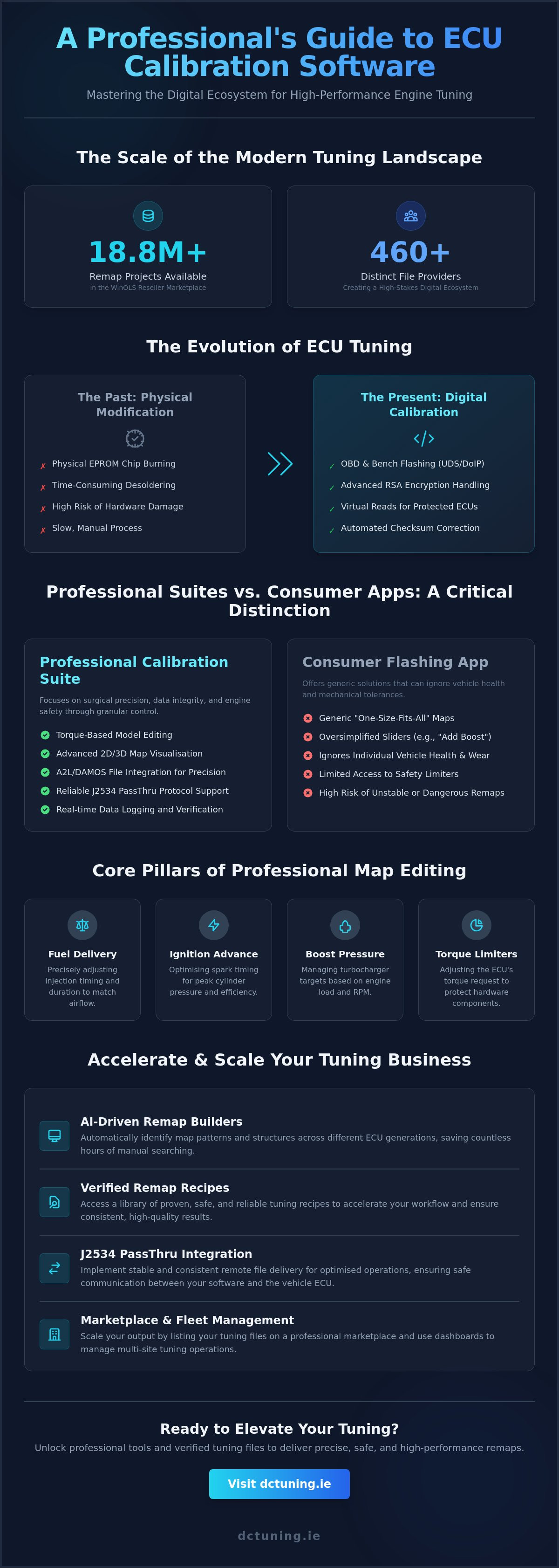
The WinOLS reseller marketplace now contains 18,872,633 projects from 463 distinct providers. This staggering volume of data proves that modern ECU calibration software has evolved into a sophisticated, high-stakes digital ecosystem. You understand that precision is non-negotiable. One wrong value can lead to a bricked ECU, whilst manual map finding drains your most valuable resource: time. High-performance results require more than just guesswork; they demand technical authority and reliable, verified tools.
You likely recognise that inconsistent file quality from generic providers puts your professional reputation at risk. It's a common frustration that slows down your workshop and limits your output. This article provides the insights needed to master the technical landscape of professional calibration tools to deliver precise, safe, and high-performance remaps. We'll examine how to accelerate your tuning workflows, access verified remap recipes, and implement reliable J2534 PassThru integration. It's time to move beyond manual searching and embrace a faster, more efficient, and highly organised software-driven approach.
Key Takeaways
- Understand the transition from physical chips to OBD flashing and master core map types like fuel, ignition, and boost.
- Evaluate the leading ECU calibration software options, comparing WinOLS raw editing against driver-based tuning for maximum precision.
- Accelerate your workflow using AI-driven Remap Builders and verified recipes to identify map patterns across different ECU generations.
- Optimise remote operations by implementing reliable J2534 PassThru integration for safe and consistent file delivery.
- Scale your professional output through marketplace listing services and fleet management dashboards to manage multi-site tuning operations.
What is ECU Calibration Software and Why is it Critical?
Professional ECU calibration software serves as the primary digital interface for re-engineering a vehicle's factory logic. It allows tuners to access, interpret, and modify the complex hexadecimal data stored within the Engine Control Unit (ECU). This isn't merely about "chipping" a car; it's a sophisticated data management process. The software acts as a bridge. It translates raw machine code into readable maps. It enables precise adjustments to ignition timing, fuel delivery, and boost pressure whilst maintaining the manufacturer-specified safety limiters that prevent engine failure. Precision defines the expert. Without high-tier software, you're just guessing.
The Evolution of Automotive Software Tuning
The industry has moved far beyond physical EPROM burning. Modern calibration relies on high-speed UDS and DoIP protocols. These allow for rapid data transfer via OBD or Bench flashing. Modern ECUs utilise complex RSA encryption and sophisticated checksum correction algorithms to prevent unauthorised tampering. Your software must handle these challenges automatically. Many modern controllers now require virtual read capabilities. This is essential for protected units where physical data extraction is restricted. It ensures data integrity. It prevents controller bricks. It secures performance results. The shift from physical hardware modification to pure software calibration has made the process cleaner, faster, and significantly more complex.
Software vs. Hardware: The Professional Distinction
High-end hardware is useless without precision-engineered software files. Consumer-grade flashing apps often offer generic, "one-size-fits-all" maps that ignore individual vehicle health. Professional engineering suites operate differently. They focus on the torque structure. They manage load. They optimise efficiency. Whilst hobbyist tools might offer simple sliders for boost pressure, professional ECU calibration software provides access to the underlying 3D maps that govern torque demand and airflow models. This level of control is what separates a standard Stage 1 Power Tune from a dangerous, unstable remap.
Professional suites provide specific functional advantages:
- Real-time data logging within the calibration environment to verify changes instantly.
- Advanced map finding using A2L or DAMOS files for surgical precision.
- Granular control over thermal protection and knock detection thresholds.
- Integration with J2534 PassThru protocols for stable communication.
Engine management logic is now based on torque-based models. You don't just "add boost" to gain power; you request more torque and let the ECU calculate the necessary parameters. Effective software manages this request safely. It respects component limits. It maintains driveability. It delivers reliability. By using a professional ecosystem, you ensure that every modification remains within the mechanical tolerances of the engine, protecting both the vehicle and your professional reputation.
Core Mechanics of Professional Map Editing
Mastering ECU calibration software requires a deep dive into the binary logic of the controller. Professional editing isn't about arbitrary changes. It's about surgical precision. It's about data integrity. You must identify the core pillars: fuel injection timing, ignition advance, turbocharger boost targets, and torque limiters. These variables interact in a complex web. Changing one necessitates adjusting others. Maintain the equilibrium. Protect the hardware. Deliver the performance.
Software interprets raw hexadecimal data and presents it through 2D and 3D visualisations. This allows you to spot anomalies, smooth transitions, and verify the logic of a curve. Professional suites move beyond simple table editing. They provide the context needed to understand engine behaviour under various load conditions. By visualising the map, you can ensure that the transition from part-load to full-throttle is linear and predictable.
Map finding is the most critical phase of the process. Whilst entry-level tools rely on automated drivers, experts use A2L and DAMOS files. These engineering documents provide the exact descriptors and addresses for every function within the ECU. This level of detail is essential for bespoke projects where standard drivers fail to provide the necessary depth. It allows you to access hidden limiters that would otherwise restrict a high-performance build.
Understanding Hexadecimal and Decimal Data
Bosch, Delphi, and Continental ECUs communicate in hexadecimal. Raw values mean nothing without proper scaling. Your software must convert these hex strings into decimal units like millibar, degrees, or milligrams per stroke. Tuning without these descriptors is dangerous. It leads to "blind tuning" where you guess the impact of your changes. Professional ECU calibration software applies the correct factors and offsets automatically. It ensures every adjustment is based on real-world physics rather than guesswork.
Safety Margins and Component Protection
High-performance results must not come at the cost of reliability. Calibrate Exhaust Gas Temperature (EGT) models. Protect turbochargers from thermal stress. Manage rail pressure to prevent hardware fatigue. Properly executed stage 1 remaps utilise the factory headroom safely. They stay within the mechanical tolerances of the engine whilst delivering significant power gains. This balance is achieved by respecting the safety limiters defined by the original manufacturer.
Calculate checksums with absolute precision before flashing. This final step ensures the vehicle starts and the ECU accepts the new data. If you're looking to accelerate your workflow, accessing a marketplace listing service allows you to source high-quality, verified files that maintain these professional standards without the time-consuming manual map finding.
Evaluating the Top Calibration Platforms for Professionals
Professional workshops face a binary choice: raw hexadecimal control or driver-based speed. Selecting the right ECU calibration software is a strategic business decision that dictates your service capability. For developers creating bespoke files, a Master configuration is essential. It provides unencrypted access to raw data. Conversely, a Slave setup suits high-volume workshops. It links the technician to a trusted file provider. This ensures speed and safety without the overhead of manual map editing. Efficiency drives profit. Precision ensures reliability. Authority builds reputation.
Cloud-based file services have further streamlined workshop throughput by automating the delivery of verified remap recipes. This integration reduces downtime. It eliminates manual file handling. It ensures consistent quality across multiple sites. By leveraging these platforms, professionals can focus on high-level diagnostics and fault finding whilst leaving the complex file engineering to specialised marketplaces.
WinOLS: The Industry Standard for Engineers
WinOLS remains the definitive choice for engineers focused on Stage 3 Track Build projects. It offers total transparency. It handles raw binary data. It integrates seamlessly with custom DAMOS databases. Whilst the learning curve is steep, the reward is absolute control over every engine parameter. Managing your own map packs requires technical discipline, but it is the only way to deliver truly bespoke performance results. It is a tool for those who understand the hex logic beneath the interface. It rewards expertise with unmatched flexibility.
J2534 PassThru: Flexibility and Accessibility
The rise of J2534 PassThru has transformed the mobile ECU remapping landscape, particularly across Ireland. This protocol enables dealer-level flashing using universal hardware interfaces. It provides mobile technicians with the flexibility to service a wider vehicle range without investing in dozens of proprietary cables. Stability is paramount. Performing high-risk write operations via J2534 requires software that can maintain communication integrity even in challenging field conditions. It bridges the gap between the workshop and the roadside. It allows for rapid deployment. It secures the data transfer.
Modern platforms now prioritise these universal protocols to reduce hardware friction. Whether you are performing a Stage 1 Power Tune or complex diagnostics, the ability to use a single interface across multiple software suites is a significant competitive advantage. It lowers entry costs. It simplifies the technician's toolkit. It ensures that your workshop remains agile in a rapidly evolving digital market. Choose a platform that supports this standard to future-proof your operations.
The Impact of AI and Automation on Remapping Recipes
Automation is transforming the workshop floor. Modern ECU calibration software no longer relies solely on manual hex-hunting. Integrated AI Copilots now identify map patterns across various ECU generations with surgical precision. This shift reduces the risk of human error. It automates repetitive tasks. It ensures consistent output. By utilising a library of over 6,700 proven recipes, tuners can skip the trial-and-error phase. Start with a verified foundation. Refine for specific hardware. Deliver results faster.
Automated checksum calculation and patch application have become standard. These features prevent the common pitfalls that lead to bricked controllers. You don't need to spend hours verifying binary integrity when the software handles the validation in real-time. This efficiency allows you to focus on the mechanical health of the vehicle rather than the minutiae of the code. Speed is the byproduct of superior tools. Precision is the result of better data.
AI-Powered Calibration Assistants
Machine learning algorithms now analyse historical data to identify optimal torque curves. This isn't generic guesswork; it's data-driven engineering. These assistants can detect "bad files" or dangerous calibration requests before they reach the ECU. They act as a digital safety net. Whilst the AI handles the heavy lifting of pattern recognition, the professional tuner remains the final "human-in-the-loop" for approval. You maintain authority. The AI provides the speed. The customer receives a reliable remap.
The Rise of the Remap Builder
Recipe-based tuning provides unmatched consistency for high-volume services like a Stage 1 Power Tune. These recipes are not static; they are adaptable frameworks. You can customise automated recipes to account for specific hardware modifications or local fuel quality. This modular approach ensures that every vehicle receives a bespoke feel without the time investment of a ground-up build. The future points toward "Virtual Dyno" integration, allowing for immediate performance simulation within the ECU calibration software environment.
Eliminate the guesswork in your workshop. Access professional-grade tools and verified data to scale your operations safely. If you're ready to integrate these advanced workflows into your business, gain Remap Builder Access today to start using verified recipes for your performance builds.
Scaling Your Tuning Business with the Right Software Ecosystem
Scaling a workshop demands a transition from manual processes to an integrated digital ecosystem. Effective ECU calibration software should do more than edit maps; it must manage your business. Implement a fleet management dashboard to oversee multi-site operations from a single pane of glass. Centralise your data. Track your throughput. Secure your files. This level of organisation is what separates a hobbyist from a professional leader. You need a system that grows with your volume.
Financial efficiency is equally critical for long-term growth. Platforms that allow for high commission retention—up to 92%—empower tuners to reinvest in their craft and hardware. Don't settle for restrictive networks that drain your margins. Instead, join a marketplace that values your technical authority. By using a Marketplace Listing Service, you can monetise your verified recipes whilst maintaining full control over your intellectual property. It's about owning your work, not just renting it.
Professional diagnostics & fault finding remain the foundation of any performance upgrade. You cannot calibrate what you haven't diagnosed. Ensure your software ecosystem integrates diagnostic data with the tuning environment. This holistic approach prevents hardware failure. It builds customer trust. It ensures that every Stage 1 Power Tune or Stage 2 Performance Tune is delivered on a healthy engine. High-performance results require a healthy baseline.
Managing Files and Customers Efficiently
A centralised webapp is essential for tracking every vehicle remap that passes through your shop. Organise your custom map database for rapid retrieval. This reduces the time spent searching for previous projects and ensures consistency for returning clients. Professional support and Remap Builder access are vital tools for reducing workshop downtime. When you have a library of verified data at your fingertips, you can handle complex requests with speed. Efficiency drives profit. Organisation ensures quality. Speed builds loyalty.
Joining a Professional Calibration Network
The transition from a solo technician to a platform-enabled business requires a shift in mindset. Leverage verified recipes to offer Stage 1, 2, and 3 services nationally without the overhead of ground-up development for every vehicle. This allows you to scale your reach whilst maintaining the high standards of a Stage 3 Track Build. You aren't just a service provider; you're part of a professional calibration network that prioritises precision and performance. It's time to elevate your workshop's output and join a community of experts.
Take the next step in your professional journey. Explore the DCTuning Remap Builder and join our professional marketplace today to access the tools needed for high-performance scaling.
Elevate Your Calibration Standards
The transition from manual hex editing to automated, data-driven ecosystems is now complete. You've seen how professional ECU calibration software manages torque structures, protects hardware, and streamlines workshop throughput. Precision is the baseline. Speed is the differentiator. Authority is the result. Success in the modern tuning landscape requires a combination of human expertise and advanced automation. Rely on a system that provides the technical foundation for growth.
Scale your operations with confidence by utilising 6,700+ verified remap recipes and an AI-powered tuning copilot. These tools eliminate guesswork. They secure your reputation. They drive efficiency. If you're ready to maximise your workshop's potential, join a platform that offers up to 92% commission for marketplace tuners. Take control of your data and future-proof your business today.
Access the DCTuning Professional Remap Builder to integrate these advanced tools into your daily workflow. Your journey toward technical excellence starts with the right partner.
Frequently Asked Questions
What is the best ECU calibration software for beginners?
Beginners should prioritise driver-based platforms like ECM Titanium or specific handheld tool interfaces. These systems offer a lower barrier to entry by translating hexadecimal data into readable maps automatically. They provide a guided environment that helps prevent critical errors whilst you learn the fundamentals of engine management. Focus on mastering Stage 1 Power Tune logic before moving to raw engineering suites.
Can I use J2534 PassThru software for all vehicles?
No. Whilst the J2534 protocol is a universal standard, its effectiveness depends on the specific vehicle's communication architecture. Most modern cars post-2005 support this standard for OBD flashing. However, some protected controllers require specific Bench or Boot mode hardware to bypass encryption. Always verify protocol compatibility with your ECU calibration software provider before attempting a write operation on an unfamiliar unit.
Is WinOLS better than ECM Titanium for professional use?
The two platforms serve different operational goals. WinOLS is the definitive choice for Stage 3 Track Build development and bespoke map finding. It provides raw, uninhibited access to binary data. ECM Titanium excels in high-volume environments where speed is paramount. It uses automated drivers to accelerate the delivery of Stage 1 and Stage 2 files. Professional workshops often utilise both to balance precision with throughput.
How does ECU calibration software affect engine reliability?
Software is the primary safeguard for mechanical longevity. High-quality ECU calibration software maintains factory safety margins for Exhaust Gas Temperature (EGT), rail pressure, and knock detection. Reliability is compromised only when a tuner ignores these limiters to chase unsustainable power figures. Professional software ensures that every modification respects the mechanical tolerances of the hardware. It protects the engine. It secures the turbo. It ensures durability.
What is the difference between a Master and Slave tuning tool?
A Master tool allows you to read, write, and edit unencrypted files freely. It is designed for tuners who develop their own calibration recipes. A Slave tool is locked to a specific Master. It reads and writes encrypted files that can only be modified by the parent Master. Slave tools are the most efficient choice for workshops focused on Mobile ECU Remapping who source files from a central marketplace.
Do I need a rolling road dyno to use calibration software?
No. Whilst a rolling road is a valuable diagnostic tool, it is not a requirement for professional calibration. Modern software utilises high-speed data logging and "Virtual Dyno" algorithms to verify performance gains in real-world conditions. You can monitor ignition timing, boost pressure, and lambda values during road tests to ensure the calibration is perfect. Focus on data integrity. Prioritise real-world logging. Deliver verified results.
How much does professional ECU software cost in 2026?
Licensing costs depend on the level of control required. As of May 2026, a full WinOLS 5 license is priced at €869.00 excluding VAT. Professional hardware like the AutoTuner Master Tool costs approximately $4,999.99 but offers the advantage of free lifetime updates without annual subscriptions. Budget for both the initial software purchase and the ongoing costs of map packs or A2L descriptors. Efficiency requires investment.
Can AI really write a safe remap file?
AI identifies optimal map patterns and applies verified recipes with high precision. It eliminates human calculation errors in checksums and patch applications. However, AI should never operate in total isolation. A professional tuner must provide "human-in-the-loop" approval to ensure the file suits the specific vehicle's mechanical health. Use AI to accelerate the workflow. Use human expertise to verify the safety. Deliver a superior product every time.