

What if the performance figures you see online are actually capping your engine's true potential? You have likely used a remap calculator to estimate your gains. You want more power. You want sharper response. You want better efficiency. However, a generic estimate cannot account for your vehicle's unique wear, component health, or local Irish road conditions. It is natural to feel cautious about engine longevity or confused by conflicting claims from different providers.
We understand that precision matters more than marketing hype. You need a realistic path to performance that respects mechanical limits while delivering a noticeable upgrade. This guide explains how calculators generate their data and why bespoke software calibration is the only way to achieve safe, reliable results. We will examine the technical variables, clarify the cost-to-performance ratio, and give you the confidence to choose a Stage 1 Power Tune or Stage 2 Performance Tune. Move beyond the screen and start engineering real-world results.
Key Takeaways
- Learn how a remap calculator queries ECU databases to provide a baseline estimate for power and torque increases.
- Identify the mechanical ceilings of stock hardware and how engineers determine safe boost and fuelling parameters.
- Understand why ambient temperature, humidity, and fuel octane levels in Ireland cause deviations from theoretical performance figures.
- Follow a structured two-step process to verify your engine code and determine if your vehicle requires Stage 1 or Stage 2 calibration.
- Discover the technical advantages of custom software calibration and how bespoke file building unlocks performance beyond generic templates.
What is a remap calculator and how does it work?
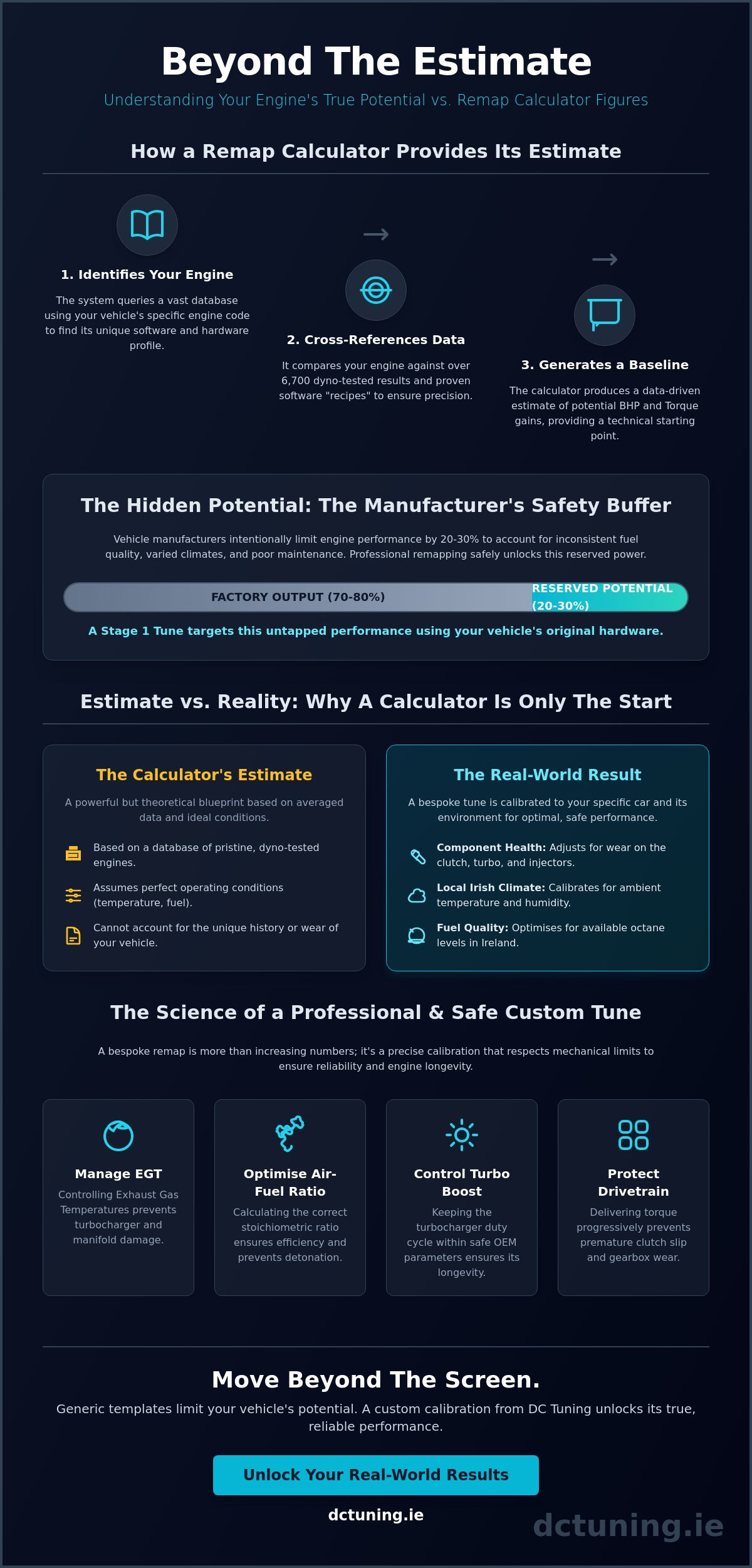
A remap calculator is a sophisticated software interface designed to provide technical transparency. It is not a guessing tool. It functions as a digital bridge between raw engine data and real-world performance potential. By querying a massive database of engine ECU architectures, the tool identifies the specific software and hardware parameters of your vehicle. It uses "recipes", specifically pre-verified software configurations, to predict increases in Brake Horsepower (BHP) and Torque. Think of it as a technical blueprint. It serves as the essential starting point for any performance upgrade, providing a roadmap for what your specific engine can safely achieve without compromising reliability.
The process is clinical. The tool identifies your engine code. It cross-references that code against thousands of previous dyno-tested results. It generates a baseline estimate. This allows you to see the projected impact of a Stage 1 Power Tune before any software is actually written. It provides a data-driven foundation that removes the guesswork from the tuning process. Analyse the data. Identify the limits. Plan the upgrade.
The difference between BHP and Torque estimates
Peak power figures often dominate the conversation, but torque defines the actual driving experience. A high-quality calculator models the entire power curve across the rev range. It shows how torque gains transform daily driving on Irish roads by providing immediate low-end response and better overtaking capability. BHP represents the top-end speed, whilst torque delivers the "pull" that gets you moving from a standstill. Balancing these two variables is critical for maintaining mid-range drivability. Modern Chip tuning techniques ensure that gains are distributed smoothly rather than hitting a single, unstable peak. This approach protects your drivetrain while maximising the "seat-of-the-pants" feel that owners crave.
Database-driven vs. AI-enhanced calculations
The tuning industry has moved beyond static lookup tables. Traditional tools were often rigid and relied on outdated information. Modern systems use algorithmic modelling to provide more accurate, dynamic forecasts. Our Remap Builder Access leverages a library of over 6,700 proven recipes, ensuring precision for almost any modern ECU type. We have shifted toward AI-assisted performance forecasting to account for complex variables in real-time. This creates a smarter, more reliable estimation process that evolves as new engine architectures are released. This technology allows for a high degree of professional confidence. Select your vehicle. Review the data. Unlock the potential.
The science of the calculation: Software vs. Hardware limits
Every engine leaves the factory with a built-in safety buffer. Manufacturers intentionally leave a performance margin of 20% to 30% to account for low-quality fuel, extreme climates, or neglected service intervals. A professional remap calculator targets this specific headroom. It identifies the "Stage 1" ceiling, which is the maximum stable output achievable using entirely stock hardware. Engineers do not simply "turn up the boost". They analyse the volumetric efficiency of the block. They calculate the stoichiometric air-fuel ratio. They adjust spark advance to prevent detonation. This technical precision separates a professional calibration from a dangerous, unverified file.
Gain profiles vary significantly between fuel types. Diesel engines are torque-biased due to their high-compression design and high-boost capabilities. Petrol engines require more nuanced adjustments to the wastegate duty cycle and variable valve timing to broaden the power band. A calculator provides the theoretical data, but the hardware defines the final limit. Professional software respects these mechanical boundaries. It prioritises stability. It ensures reliability. It delivers measurable results.
Preserving component longevity whilst increasing output
Managing Exhaust Gas Temperatures (EGT) is the primary concern for engine longevity. Excessive heat destroys turbocharger bearings and exhaust manifolds. We use software to monitor these levels, ensuring the turbocharger duty cycle remains within its design parameters. A remap calculator must be conservative because it cannot physically inspect the condition of your clutch or drivetrain. Whilst high-end vehicle test procedures define theoretical peaks, real-world longevity depends on respecting mechanical fatigue. We ensure the torque delivery is progressive to protect your gearbox and prevent premature clutch slip.
The role of the ECU in the calculation
The Engine Control Unit (ECU) is the master regulator. It interprets new map data and adjusts parameters in real-time using closed-loop feedback from oxygen and knock sensors. After a software flash, the ECU initiates adaptive learning behaviour to fine-tune itself to the new calibration. Generic maps often fail here. They are "blind" to individual engine wear, such as a slightly tired fuel pump or carbon-clogged intake valves. Custom software calibration identifies these variables. It adapts to the engine's current state. It provides a safer, more efficient power delivery. For a precise assessment of your vehicle's potential, explore a Stage 1 Power Tune designed specifically for Irish road conditions.
Why calculator estimates differ from real-world dyno results
A remap calculator provides a theoretical target based on optimal conditions. It operates in a mathematical vacuum. In reality, performance is dictated by the immediate environment. Ambient temperature directly affects air density. High humidity levels, common across Ireland, can alter combustion efficiency. Altitude changes oxygen availability. These environmental variables mean a car tuned in a controlled lab will produce different figures than the same car driven on a damp morning in a typical Irish climate. Understand the variables. Observe the environment. Adjust the expectations.
Mechanical health is the ultimate filter for performance. A remap calculator assumes your engine is in peak condition. It cannot see a tired turbocharger that struggles to meet boost targets. It cannot detect carbon build-up in the intake manifold restricting airflow. It cannot identify worn injectors delivering inconsistent fuelling. Additionally, the method of measurement matters. Rolling roads introduce variables like tyre pressure, strap tension, and cooling fan efficiency. Hub dynos eliminate tyre slip but still provide data that may vary from software-only estimates. Use the calculator as a guide, but rely on diagnostics to confirm the reality.
Static calculators vs. Virtual Dyno data
Static calculators rely on fixed data points from historical lookups. They are useful for initial research but limited in execution. Professional platforms now use Virtual Dyno data to bridge the gap. By using J2534 PassThru protocols, we log real-time performance data during the calibration process. Monitor boost pressure. Track ignition timing. Log mass airflow. This high-resolution logging verifies if the engine is actually hitting the targets set by the software. It transforms a target into a verified result. It provides the technical transparency required for high-end tuning.
The "Unrealistic Gains" trap
Avoid the pursuit of peak numbers at the expense of reliability. Some providers use optimistic calculators to lure customers with inflated BHP claims. These figures often exceed the physical flow limits of the stock turbocharger. Pushing a component beyond its design specifications leads to heat soak, component fatigue, and eventual failure. A lower, smoother power curve is almost always faster in real-world driving. It provides better traction. It reduces drivetrain stress. It ensures consistent performance throughout the rev range. Prioritise drivability over spreadsheet bragging rights. Choose a provider that values mechanical integrity over hyperbole.
How to interpret your vehicle’s performance potential
Interpreting data from a remap calculator requires a technical eye. You must look beyond the headline figures to understand how that power translates to the road. Start with the hardware. Follow a structured verification process to ensure the data applies to your specific vehicle. Use this four-step framework to evaluate your potential gains:
- Step 1: Verify your engine code and ECU type. Manufacturers often use the same displacement for different power outputs. A 2.0 TDI might have three different turbocharger specs across various models. Identify your specific engine code to ensure the calculation is accurate.
- Step 2: Compare Stage 1 vs. Stage 2 hardware requirements. Stage 1 is designed for stock components. Stage 2 requires physical upgrades. If a tool suggests Stage 2 gains without mentioning a downpipe or intercooler, the data is flawed.
- Step 3: Look for torque delivery. Peak numbers are for brochures. Real performance comes from the area under the curve. Analyse how early the torque arrives and how long it stays.
- Step 4: Assess the file provider. The tool is only as good as the engineer who wrote the "recipe". Research the provider to ensure they use custom calibration rather than generic, high-risk templates.
Be alert for "Red Flag" gains. If a remap calculator promises a 40% increase in power on a stock turbocharged petrol engine without hardware changes, exercise caution. These claims often indicate poor software quality that bypasses factory safety limiters. Professional tuning prioritises a sustainable increase, typically ranging from 20% to 30% for most modern turbocharged vehicles in Ireland. Prioritise reliability. Protect your investment. Choose precision over hyperbole.
Understanding the Stage 1 Remap
A Stage 1 Power Tune is the most efficient upgrade for daily drivers. It optimises the factory software whilst staying within the mechanical tolerances of stock components. Turbocharged diesel engines often see significant improvements in fuel economy alongside power increases. Turbocharged petrol engines gain sharper throttle response and a broader power band. It is a clean, non-invasive process that transforms the driving experience without requiring mechanical modifications. It is the standard for a reason.
Moving to Stage 2 and beyond
Stage 2 Performance Tune calibration requires hardware synergy. The software must be adjusted to account for increased airflow from an upgraded intake or reduced backpressure from a high-flow exhaust. Without these physical changes, the ECU will pull back power to protect the engine from heat soak. Stage 3 builds involve even more complexity, often requiring larger turbochargers and uprated fuel systems. This level of tuning is a bespoke engineering project designed for track use or high-performance applications. If you are ready to see what your car can really do, book a Stage 1 Power Tune today and experience professional calibration.
Beyond the numbers: Custom calibration with DCTuning
A remap calculator is an excellent diagnostic starting point, but it is not the final solution. Real performance is engineered, not just calculated. At DCTuning, we move beyond generic estimates to provide bespoke software calibration. We build every remap file from scratch to suit the specific health and requirements of your engine. This approach ensures that every Stage 1 Power Tune or Stage 2 Performance Tune delivers maximum efficiency without compromising safety. We support individual owners seeking better drivability and professional tuners looking for high-end file support. Our national coverage ensures you can access our expertise through Mobile ECU Remapping or at our professional workshop centre.
Innovation drives our process. We utilise the latest Alientech KESS3 hardware and WinOLS software to ensure precision at the code level. Our Remap Builder Access and AI Copilot tools allow for rapid, accurate file development that respects the unique architecture of modern ECUs. We maintain a verified Marketplace Listing Service where only the highest quality tuning recipes are available. This categorical approach guarantees that your vehicle receives a tailored solution rather than a one-size-fits-all template. Secure the gain. Maintain the reliability. Trust the experts.
Professional software for a precision finish
Precision requires the right tools. We use industry-standard WinOLS and Alientech protocols to modify maps with surgical accuracy. This allows us to adjust thousands of data points, from fuel rail pressure to ignition timing. Every file is tailored to your specific vehicle, accounting for its mileage, service history, and existing modifications. By using a verified marketplace for our recipes, we ensure that every calibration has been tested and proven. This technical rigour provides the professional confidence you need when modifying your vehicle's brain. Analyse the code. Optimise the parameters. Execute the flash.
Get started with a professional consultation
A basic remap calculator cannot hear a misfire or see a boost leak. A conversation with a qualified technician provides the context that software alone lacks. Before any flash occurs, we recommend a thorough session of Diagnostics & Fault Finding to ensure your hardware is ready for the increase in load. Whether you are looking for a Stage 1 Power Tune to improve your daily commute or a Stage 3 Track Build for the circuit, we provide the technical authority to get it right the first time. Experience the DCTuning difference today and unlock the true potential of your engine with bespoke calibration.
Execute Precision Calibration Today
A remap calculator is an essential starting point for any performance upgrade. It defines the theoretical boundaries. It identifies the potential BHP and Torque increases. It provides a roadmap for your engine's future. But data alone cannot account for real-world variables like component wear or fuel quality. Professional results require a shift from simple estimation to technical execution. You must respect mechanical limits while prioritising drivability and longevity.
We bridge the gap between theoretical data and high-performance reality. Our engineering team builds custom files from scratch to match your specific ECU architecture. We leverage a library of over 6,700 proven tuning recipes to ensure precision. We utilise professional J2534 PassThru flashing protocols for a secure, stable software update. This clinical approach eliminates the risks associated with generic templates. Don't settle for basic estimates when you can have engineered excellence. Calculate your real performance potential with DCTuning and experience the technical authority of bespoke calibration. Start your journey toward a safer, more powerful drive today.
Frequently Asked Questions
Is a remap calculator 100% accurate for every car?
A remap calculator provides a baseline estimate rather than a guaranteed figure. It cannot account for individual engine health, component wear, or specific sensor tolerances. Use these figures as a technical target that must be verified through real-time data logging during the calibration process. Every engine is unique, so the final output depends on the physical condition of your hardware at the time of the flash.
Can a remap calculator predict fuel economy improvements?
Calculators can forecast potential fuel economy improvements based on increased low-end torque. This allows for earlier upshifting and reduced throttle input at cruising speeds, particularly in turbocharged diesel engines. However, real-world efficiency depends heavily on driving behaviour and road conditions across Ireland. Whilst the software optimises combustion, the driver’s right foot remains the primary variable for final MPG or Litres per 100km figures.
What is the difference between Stage 1 and Stage 2 gains on a calculator?
Stage 1 gains represent the maximum stable output for a vehicle with entirely stock hardware. Stage 2 gains account for physical modifications such as a high-flow downpipe or an uprated intercooler. A professional remap calculator will clearly distinguish between these two tiers to prevent mechanical overloading. It ensures that the software calibration matches the physical breathing capabilities of the engine.
Why do some calculators show higher gains than others for the same car?
Different tools rely on different database sources and safety philosophies. Some providers use optimistic figures to attract customers, while professional tools prioritise mechanical longevity. High-end platforms use data from thousands of verified dyno runs to provide realistic targets. Always choose a tool backed by proven tuning recipes rather than one promising the highest possible peak numbers without technical justification.
Does a remap calculator take engine mileage into account?
Most calculators assume the vehicle is in optimal mechanical condition. They don't factor in engine mileage or the state of wear on components like the turbocharger or injectors. High-mileage vehicles require a thorough diagnostic scan before any software flash to ensure they can handle the increased load. If your vehicle has significant wear, a technician may choose a more conservative calibration than the calculator suggests.
Will a Stage 1 remap exceed my car’s factory safety limits?
A professional Stage 1 remap is designed to stay within the manufacturer's built-in safety margins. Engineers target the existing performance buffer without exceeding the design limits of the engine block or drivetrain. It optimises efficiency whilst preserving the structural integrity of the vehicle. By respecting these factory limiters, the calibration provides a noticeable power increase without compromising long-term reliability.
How do I verify the gains promised by a remap calculator?
Verification requires empirical data from a rolling road or a hub dyno. Alternatively, professional tuners use J2534 PassThru logging to monitor boost pressure, mass airflow, and ignition timing in real-time. This high-resolution logging confirms if the engine is actually meeting the targets set by the software. It provides a transparent look at how the car is performing under load compared to the initial estimate.
Can I use a remap calculator for a car with a modified exhaust?
You can use a calculator for modified vehicles, but the results will likely vary from the stock estimate. A modified exhaust reduces backpressure, which often allows the turbocharger to spool faster and more efficiently. In this scenario, a custom Stage 2 Performance Tune is usually required to fully exploit the hardware changes. The software must be specifically calibrated to manage the altered airflow and exhaust gas temperatures.