
Disconnected tools. Fragmented data. Wasted fuel. Why is your national fleet still operating on software guesswork? Most fleet managers recognise that precision remapping is the fastest route to slashing operational costs, yet tracking the actual ROI across hundreds of vehicles remains a logistical nightmare. You likely struggle with visibility into which units are calibrated and which are burning through your margins. With diesel prices remaining highly volatile across Ireland, you cannot afford to leave engine performance to chance.
By implementing a dedicated fleet management tuning dashboard, you gain absolute control over your digital assets. You deserve a system that simplifies software deployment, validates fuel efficiency gains, and eliminates administrative friction. This article demonstrates how a centralised platform transforms fleet performance from a variable expense into a controlled, high-output asset. We will examine how to achieve a single source of truth for your remap files, streamline national software updates, and secure the measurable ROI that modern fleet orchestration demands.
Key Takeaways
- Move beyond basic logistics. Transition from simple GPS tracking to comprehensive vehicle performance orchestration.
- Gain absolute visibility. Use a fleet management tuning dashboard to monitor J2534 PassThru flashing status and manage software deployment across all units.
- Maximise fuel efficiency. Track measurable ROI by comparing consumption trends before and after Stage 1 Power Tune calibration.
- Streamline your workflow. Deploy verified software recipes via the Remap Builder to ensure consistency across your entire national fleet.
- Reduce operational risk. Organise phased software rollouts to maintain uptime whilst scaling performance capabilities through the DCTuning marketplace.
Centralising Vehicle Performance: Why Tuning Dashboards Matter in 2026
Traditional fleet management systems focus on the "where" and the "when". They track GPS coordinates. They log driver hours. They monitor safety compliance. Whilst these metrics remain essential, they ignore the most critical variable in your operational cost: engine efficiency. A fleet management tuning dashboard represents a shift in focus. It serves as a centralised hub for ECU software, moving beyond simple asset tracking into performance orchestration. It's a high-end tool for experts who value precision over guesswork.
Modern fleet management requires more than just visibility; it demands control. Traditional tools tell you a vehicle is moving. A tuning-specific platform tells you how efficiently it's moving. By managing the software layer of your fleet, you eliminate the inconsistencies that plague large-scale operations. You aren't just watching your vehicles; you're dictating their performance profiles. Control. Consistency. Calibration. These are the pillars of a modern, software-driven fleet.
The Shift from Tracking to Performance Calibration
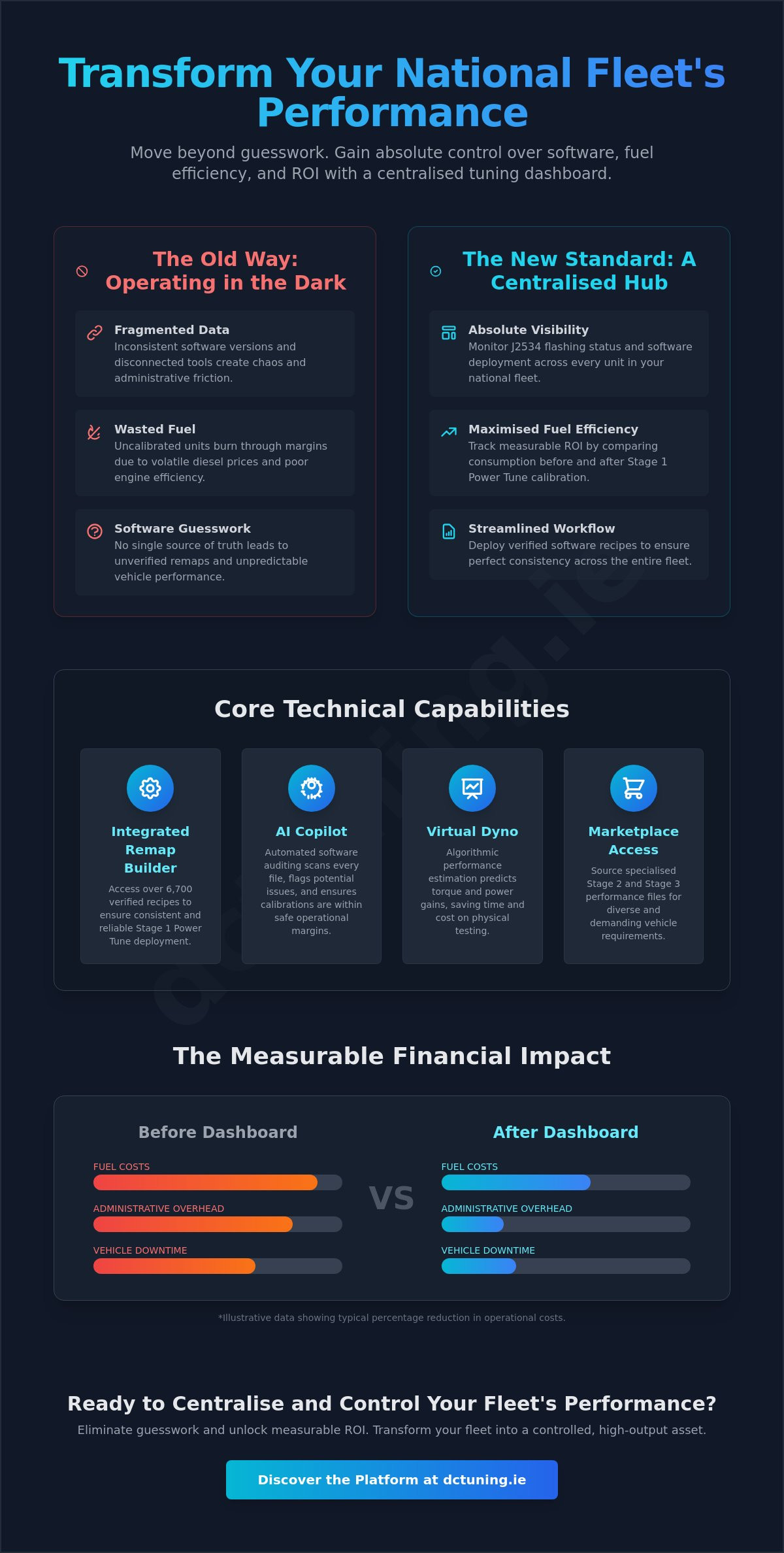
Relying solely on location data is a legacy approach. In a market where diesel prices are volatile and margins are thin, software is your most powerful lever. ECU remapping is now a standard pillar of commercial fleet strategy. It allows you to tailor engine behaviour to specific duty cycles. Centralising these software versions ensures absolute consistency amongst every vehicle in your fleet. Every van. Every truck. Every mile. A fleet management tuning dashboard guarantees that a Stage 1 Power Tune applied to one vehicle within your national fleet is identical to that applied to any other. This level of software integrity prevents performance drift and ensures that fuel savings are realised across the entire national network.
Overcoming Data Fragmentation in Fleet Operations
Fragmented data is the enemy of efficiency. Using disconnected tuning tools leads to technical debt, administrative overhead, and unverified software versions. A unified dashboard eliminates these silos. It provides a single source of truth for your entire software library. You can identify which vehicles have been calibrated, monitor update statuses, and ensure every unit runs a verified, custom-built remap recipe. This streamlined workflow reduces the risk of human error. It allows your team to deploy updates with speed. It transforms a complex technical process into a manageable, transparent system that delivers high-performance results without the usual friction of national software rollouts.
Key Technical Features of a Professional Tuning Dashboard
Precision software calibration requires more than a simple spreadsheet. A professional fleet management tuning dashboard provides the technical infrastructure to manage ECU IDs, checksums, and flashing protocols at scale. It replaces manual file handling with a streamlined, digital workflow. Integrating these features is the cornerstone of efficient fleet management; ensuring that data drives every software deployment rather than intuition. This level of technical oversight is essential for maintaining the mechanical integrity of a national fleet whilst demanding maximum output.
A high-end dashboard must offer a suite of integrated tools designed for rapid, error-free execution. These include:
- Integrated Remap Builder: Access to a library of verified recipes for immediate deployment.
- AI Copilot: Automated software auditing to ensure every calibration stays within safe operational margins.
- Virtual Dyno: Algorithmic performance estimation to predict torque and power gains without physical testing.
- Marketplace Access: A direct line to specialised Stage 2 and Stage 3 files for diverse vehicle types.
Remap Builder and AI-Assisted Calibration
Consistency is the primary challenge in fleet remapping. The Remap Builder solves this by utilising over 6,700 verified recipes. This ensures that every Stage 1 Power Tune is identical across your entire fleet. The AI Copilot integration acts as an automated auditor. It scans every file for calibration errors. It flags potential issues before the flashing process begins. This proactive approach eliminates the risk of deploying unstable software. It allows fleet managers to automate the creation of tunes for high-volume rollouts without sacrificing quality or safety. Leveraging this performance software platform ensures your technical standards remain high as you scale.
J2534 PassThru and Remote Flashing Integration
Modern fleets don't have the luxury of returning to a central depot for every update. J2534 PassThru protocols are technically necessary for remote software management. A professional dashboard monitors the flashing status of every vehicle in real-time. It tracks successful deployments. It identifies hardware communication errors. It provides a clear audit trail of which vehicles are running which software version. This visibility allows you to manage remote updates whilst vehicles are in the field, reducing downtime and ensuring that every unit is operating on the most efficient calibration available. You gain a granular view of the flashing process, from the initial handshake to the final checksum verification.
The Financial Impact: Managing Fuel Economy and Software ROI
Managing a national fleet requires a ruthless focus on the bottom line. Every cent counts. Every litre matters. Whilst standard fleet management software focuses on driver behaviour and route planning, it often overlooks the vehicle's inherent efficiency. A fleet management tuning dashboard bridges this gap. It allows you to calculate the precise ROI of a fleet-wide Stage 1 Power Tune. It provides the visibility needed to turn engine calibration from a technical upgrade into a strategic financial asset. Measure. Manage. Maximise. This is how you reclaim your margins.
Moving from a retail, per-vehicle model to a fixed-fee software service changes the economic landscape. It eliminates the high entry costs of traditional tuning. It allows for rapid, fleet-wide deployment without unpredictable invoices. You gain access to professional-grade software at a scale that makes sense for commercial operations. This shift ensures that your investment in performance is predictable, transparent, and highly profitable.
Stage 1 Tuning as a Cost-Reduction Strategy
Torque is the key to commercial efficiency. A Stage 1 Power Tune optimises torque delivery at lower engine speeds. This allows your vehicles to maintain cruising speeds in higher gears with less throttle input. It reduces mechanical load. It lowers RPMs. It slashes fuel consumption. For a national diesel fleet, a professional Stage 1 remap typically yields between 10% and 15% in fuel savings. When you quantify this "cent-per-kilometre" reduction across fifty or a hundred vehicles, the annual savings are substantial. You aren't just saving fuel; you're engineering a more profitable operation through precision software.
Lifecycle Management and Maintenance Savings
Generic tuning "chips" or external boxes are a liability. They trick sensors. They bypass safety limits. They cause premature engine wear. In contrast, custom-built files respect factory safety margins whilst unlocking latent efficiency. By using a fleet management tuning dashboard, you integrate Diagnostics & Fault Finding into your routine maintenance. This allows you to catch failing components before they cause a breakdown. Catching a restricted DPF or a deviating injector early saves thousands in recovery fees and emergency repairs. It maintains uptime. It extends vehicle life. It ensures your fleet remains a reliable asset rather than a mounting liability.
Best Practices for National Fleet Software Deployment
Deploying software across a national fleet is not a "one-click" operation. It requires a methodical framework to maintain operational stability. A fleet management tuning dashboard provides the necessary structure to move from fragmented updates to a controlled rollout. Start by establishing a baseline performance profile for every vehicle. You cannot verify an improvement if you haven't documented the starting point. Log the current ECU state. Create a digital twin of the vehicle's software history within the dashboard. This digital record serves as your safety net; ensuring you have an immediate recovery point if hardware failure occurs during a flash.
Professional standards demand professional tools. Equip your field technicians with verified J2534 hardware. Using high-quality interfaces like AlienTech or ECM Titanium ensures stable communication between the dashboard and the vehicle's diagnostic port. Cheap, unverified clones are a liability. They brick ECUs. They cause unnecessary downtime. They destroy your ROI. Standardising your hardware is as critical as standardising your software.
Phased Rollout and Software Version Control
Never update an entire fleet simultaneously. It's a high-risk strategy that ignores hardware variance. Organise your deployment into logical stages. Start with a small control group. Test your remap recipes on this subset first. Monitor their fuel consumption and performance data for several days. If the dashboard validates the efficiency gains, proceed to the next phase. The fleet management tuning dashboard allows you to manage this hierarchy effortlessly. If a specific hardware revision reacts poorly, you can "roll back" that specific group to the factory file in minutes. This maintains uptime whilst you refine the calibration for that specific sub-group.
Technician Accountability and Protocol Standards
Security and accountability are paramount in large-scale operations. Set strict user permissions within your platform. Control who can download files. Control who can initiate a flash. Every software change must be logged to create an immutable audit trail. This transparency is vital for future diagnostic clarity. If a vehicle requires Diagnostics & Fault Finding during a routine service, your team can see exactly which software version was applied and which technician performed the update. This prevents unauthorised "cowboy" tuning and ensures every unit adheres to your central performance standards. To secure your fleet's software integrity, get started with Remap Builder Access and take control of your deployment protocols.
Scaling Your Operations with the DCTuning Performance Platform
Scaling a national operation requires a platform that grows with your ambitions. The fleet management tuning dashboard by DCTuning is engineered for this exact purpose. It doesn't just sit alongside your workshop workflow; it becomes the engine driving it. Integrate. Automate. Accelerate. This platform moves your business beyond simple file requests into a fully orchestrated performance ecosystem. It's a high-precision tool designed for those who demand technical excellence at every level of their operation.
Accessing specialised files shouldn't be a hurdle. Through our integrated marketplace, you can source Stage 2 Performance Tune files and Stage 3 Track Build calibrations for diverse fleet requirements. Whether you're managing a fleet of standard logistics vans or a high-performance corporate division, the software you need is available instantly. Partnering with an Irish-based provider means you benefit from technical support that understands local vehicle specifications and the specific demands of the Irish transport sector. You gain a reliable ally that prioritises your uptime and technical integrity.
Bespoke Software Solutions for Every Fleet Tier
We recognise that fleet managers and technical tuners have different priorities. The DCTuning dashboard features a modular interface tailored to these specific roles. Managers track ROI, fuel trends, and deployment schedules. Tuners access ECU IDs, checksum verification, and the Remap Builder. This ensures that everyone has the data they need without unnecessary clutter. It's a platform built by tuners, for tuners, ensuring that technical depth is never sacrificed for ease of use. From standard delivery vehicles to bespoke performance projects, our software solutions adapt to your specific operational goals.
Getting Started: Integration and Onboarding
Transitioning to a new system must be seamless. Our onboarding process is designed to migrate your existing fleet data into the DCTuning platform with zero disruption. We assist in setting up your J2534 environment to ensure your hardware communication is stable from day one. You can begin seeing immediate performance gains and fuel savings across your units as soon as the integration is complete. Don't leave your fleet's efficiency to legacy systems. Enquire about our Fleet Management Dashboard solutions today and secure the future of your national operations.
Secure Your Competitive Edge with Performance Orchestration
The transition from simple tracking to software-driven performance is no longer optional for Irish operators. It's a technical necessity. By centralising your ECU calibrations, you eliminate data fragmentation and secure measurable fuel savings. You've seen how a professional fleet management tuning dashboard transforms administrative overhead into streamlined, high-output execution. It's about control. It's about consistency. It's about results. You aren't just managing vehicles; you're orchestrating a high-performance network.
Our platform provides the tools you need to lead. Access over 6,700 verified remap recipes. Deploy custom-built files from scratch. Benefit from a marketplace that offers a 92% commission for specialised tuners. You deserve a system that matches your technical competence and supports your growth across the national network. This is the future of fleet efficiency; precise, transparent, and highly profitable. Take the next step in your digital transformation. Optimise your fleet performance with the DCTuning Dashboard and redefine your operational limits. Your fleet is ready for the next level of efficiency.
Frequently Asked Questions
What is a fleet management tuning dashboard?
A fleet management tuning dashboard is a centralised digital hub designed to manage ECU software across a national vehicle network. It allows you to deploy calibrations, track performance metrics, and maintain version control from one interface. This system replaces fragmented tools with a single source of truth; ensuring every vehicle in your fleet operates on verified, high-efficiency software.
Can I manage remapping for different vehicle makes in one dashboard?
Yes, the platform supports a broad spectrum of manufacturers and ECU types within a unified environment. You can manage diverse fleets including Ford, Mercedes-Benz, and Volkswagen without switching between different software applications. This multi-make compatibility eliminates technical silos and ensures that your data logging remains consistent across your entire commercial operation.
Is the tuning software compatible with J2534 PassThru tools?
Yes, the system is fully compatible with J2534 PassThru hardware and protocols. This allows you to use professional-grade interfaces such as AlienTech KESS3 or high-end Autel devices for stable, reliable flashing. It ensures that your current hardware investment remains viable whilst you upgrade to a more sophisticated fleet management tuning dashboard for better oversight.
How does a tuning dashboard help reduce fleet fuel costs?
The dashboard facilitates the deployment of Stage 1 Power Tune calibrations that optimise torque delivery at lower engine speeds. By increasing low-end torque, vehicles maintain cruising speeds with less throttle input and lower RPMs. This engineering shift leads to a measurable reduction in fuel consumption; typically yielding savings between 10% and 15% for national diesel fleets.
Is it possible to revert a fleet vehicle to factory software settings?
Yes, the platform maintains a permanent digital record of every vehicle's original factory ECU file. You can restore a vehicle to its stock software settings in minutes via the dashboard interface. This capability is vital for preserving resale value, adhering to lease return conditions, or troubleshooting mechanical issues that require a baseline software state.
Does the dashboard provide diagnostics for fault finding?
Yes, the platform integrates Diagnostics & Fault Finding tools to monitor vehicle health in real-time. You can scan for Diagnostic Trouble Codes (DTCs) and analyse live data before applying any software updates. Identifying restricted DPFs or deviating injectors early prevents emergency breakdowns and keeps your fleet assets on the road rather than in the workshop.
How does the AI Copilot assist in fleet remapping?
The AI Copilot serves as an automated software auditor that scans every remap file for calibration errors. It verifies checksums and ensures that all parameters remain within safe mechanical margins before the flashing process begins. This proactive safety layer eliminates human error; ensuring that every software deployment is stable, safe, and optimised for longevity.
Can I use the dashboard to manage mobile tuning technicians?
Yes, the dashboard is engineered to coordinate Mobile ECU Remapping across multiple geographic locations. You can assign specific user permissions, track real-time technician activity, and manage file deployments for your field-based teams. This provides the visibility needed to ensure that every mobile unit follows your central performance protocols and maintains high service standards.